
A Perspective That Bridges "Business" and "the Front Lines":
Yasuko Akutsu on the Present and Future of Robotic Care Equipment
=Part 2 =
Japan is rapidly entering a super-aging society. Amid this situation, where the country faces the major challenge of a future shortage of care workers, significant attention is being focused on the introduction of technology into the care sector—particularly the use of robotic care devices—as one potential solution.
For this article, the Care Robot Portal interviewed Yasuko Akutsu, a leading expert in healthcare design and the evaluation of medical and care devices, to learn about her insights and key concepts regarding the development of robotic care devices.We will publish the interview in two parts: Part 1 and Part 2.
Click here to read Part 1 of Yasuko Akutsu’s biography.
What Is the Development of User-Friendly Robotic Care Devices?
―― You mentioned that there are two key points in the development of robotic care devices: the first is “setting development goals that involve the actual care setting.” Could you explain what you mean by the second point, “emphasizing ease of use”?
I believe one reason why robotic care devices, despite being developed, end up not being used in practice is that “by trying to make them convenient, we end up loading them with too many features, which makes them difficult to use.”
―― So, it’s not necessarily the case that a robot with many features and high performance is the best solution.
That’s right. This also ties back to the importance of setting clear goals. I think it’s common for the primary objective of product development to become “incorporating every technology the development team possesses,” which often results in a finished product that’s difficult to use. In Japan, in particular, I feel there are many cases where the focus is on developing devices with multiple functions.
―― How can we develop devices that are easy to use in the field?
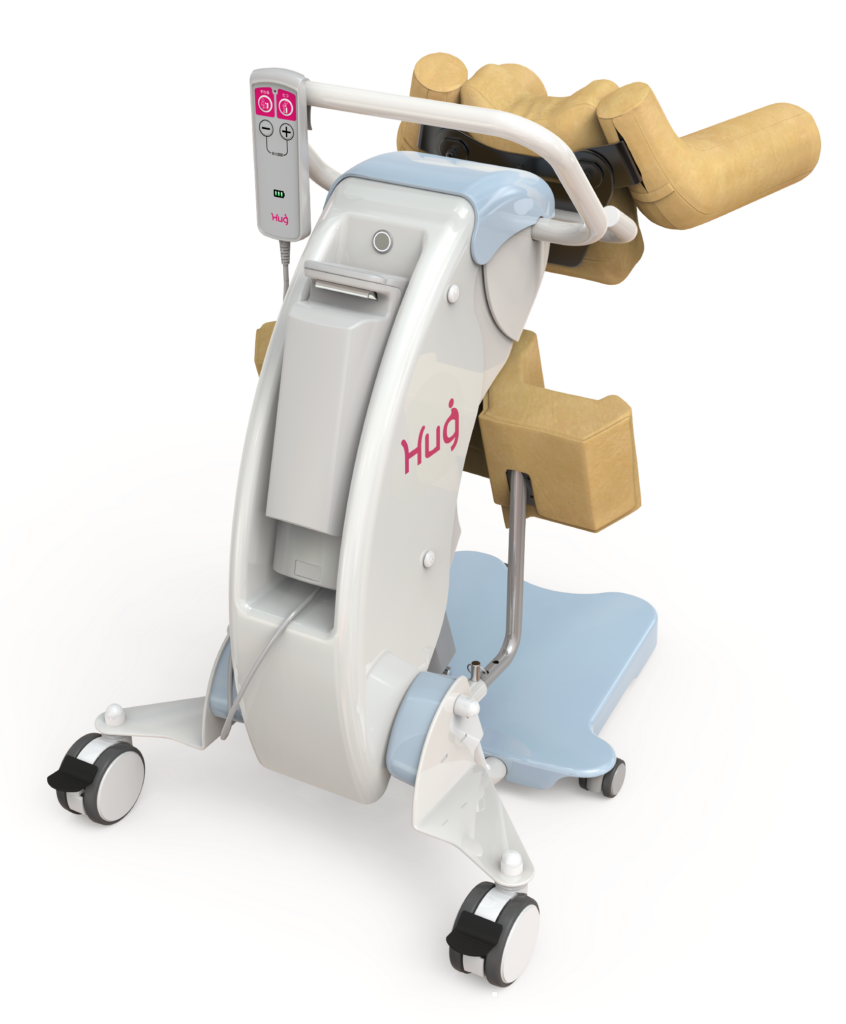
The key is to take the step of stripping away unnecessary functions. When a device has many functions, the options for how to use it increase, making it prone to becoming complex.Instead, products with clearly defined purposes and usage methods are more valuable in the field. To achieve this, it is necessary to identify the bare minimum of required functions and eliminate the unnecessary ones. This is where the earlier point about setting clear goals becomes extremely important. Cutting features is a process that requires a great deal of courage, but clarifying the goal makes it possible. As an example of a company that successfully developed a product by following such steps, I would cite FUJI Co., Ltd. (*4).Starting with their initial prototype of a support robot, they reportedly conducted extensive testing in Denmark, stripping away unnecessary features to create a robot specialized for patient transfer. I believe there are few Japanese developers who engage in this process of gathering feedback from the field based on prototypes and narrowing down to only the necessary functions.
*4: FUJI Co., Ltd.’s patient transfer support robot “Hug” (https://www.fuji.co.jp/about/hug/
)
Develop the ability to identify the root causes of issues in long-term care settings
―― It’s important to incorporate feedback from the field into product development,
isn’t it? That’s right. However, when I look at the caregiving environment, I also believe there’s an issue where feedback to developers of robotic care devices is insufficient.
―― Are you referring to challenges on the part of the care workers who use these robotic care devices?
I believe that in today’s Japanese care settings, there is a lack of “the ability to generate needs from the field”—that is, the capacity to identify which tasks within their daily work cause inconvenience and where there is room to incorporate tools like robotic care devices.
―― So, the process of identifying needs from the field isn’t easy, is it?
When we talk about “needs,” it’s often perceived as simply verbalizing current inconveniences or complaints, but that’s not the case.What impressed me about the Danish case study was that caregivers there consistently adopt a perspective focused on identifying “the root cause of the problem.” They investigate the root causes of issues and consider whether there is room to address them through the use of technology. I believe this way of thinking has not yet taken hold in Japan, but it is a crucial mindset for improving the on-site environment. I suspect one reason this mindset has not developed in Japan is the cultural background of the Japanese caregiving industry.In Japan, there is a deeply ingrained culture where frontline staff are expected to “figure things out” on their own when minor issues arise. Compounding this is the assumption that care is only heartfelt when it is provided by human hands. I feel that because there is no clear distinction in care settings between “tasks that can be delegated to technology” and “tasks that only humans can perform,” this closes off the possibility of identifying opportunities to utilize technology or considering the actual needs of the situation.
Working to Revise the Caregiver Training Program
―― I believe education plays a crucial role in driving cultural transformation. Professor Akutsu, you are responsible for producing and lecturing on the Medical Innovation Strategy Program and the Care DX Human Resources Development Program at Chiba University. What kind of initiatives are you undertaking there?
We are working on developing a training program for new entrants to the caregiving field. The original training program relied heavily on repeated “practical training” and placed a strong emphasis on the personal, hands-on approach typical of the workplace.We are currently working to fundamentally transform that approach.
―― Specifically, how have you changed the content?
We have participants engage in a hands-on, trial-and-error process of introducing technology into actual care settings. In this year’s program, we’ve incorporated some technology to replace certain care tasks, allowing participants to experience firsthand how technology can improve on-site operations. At the same time, we’re conducting practical exercises where they develop a framework to evaluate whether various care devices are actually useful in real-world settings.
―― So, when care workers themselves clearly communicate their specific needs, it leads to the development of more practical robotic care devices, right?
That’s correct. If care workers don’t clearly define their needs, developers will end up creating devices based on misguided assumptions. This leads to a vicious cycle where the robots aren’t used, and improvements on the front lines don’t progress. To avoid this situation, it would be ideal if care workers could develop the mindset to constantly look for areas where technology could improve their work and effectively communicate those needs to developers.
Developing robotic care devices that promote independence among care recipients
―― You’ve shared insights on the challenges facing robotic care devices from both the perspectives of developers and frontline care providers. I imagine there are many companies looking to enter the care device industry; how should these new entrants approach robotic care devices?
I really think developers need to see the actual care settings firsthand. It’s also crucial to clearly define the goal: “Who do we want to support, and in what way?” Furthermore, I believe that going forward, there will be a greater need for devices that promote the independence of care recipients, rather than devices designed solely for the caregivers.
―― What do you mean by devices that promote independence for care recipients?
In Japan today, when people discuss problems in caregiving, the burden on caregivers is often cited. The difference in perspective compared to Denmark is striking. For example, regarding the benefits of fall-prevention monitoring devices, while Japan tends to highlight “reducing the burden on caregivers,” Denmark emphasizes that “people who used to stand up timidly now stand up with confidence, reassured by the knowledge they are being watched over.”While this focus on the caregiver’s perspective is partly unavoidable given the current shortage of care workers and workplace issues in Japan, I hope that in the future, the concept of “robotic care devices designed to help care recipients live with greater motivation” will gain traction, shifting the focus away from the caregiver’s perspective.
<The End>