A Perspective That Bridges " Business" and "the Front Lines":
Yasuko Akutsu on the Present and Future of Robotic Care Equipment
=Part 1 =
Japan is rapidly entering a super-aging society. Amid this situation, where the country faces the major challenge of a future shortage of care workers, significant attention is being focused on the introduction of technology into the care sector—particularly the use of robotic care devices—as one potential solution. For this
article, the Care Robot Portal interviewed Yasuko Akutsu, a leading expert in healthcare design and the evaluation of medical and care devices, to learn about her insights and key concepts regarding the development of robotic care devices.We will publish the interview in two parts: Part 1 and Part 2.
[Profile of Yasuko Akutsu]
Graduated from the Faculty of Liberal Arts at Tsuda College; completed a Master’s degree in Environmental Science
at the Graduate School of Science, University of Tsukuba.
1982: Joined GK Industrial Design Institute, where she worked on product development concept planning, exhibition concept planning, and master plans for urban development.Subsequently, she worked at several companies where she was responsible for merchandise planning and development (MD), research, store launches, and consulting for healthcare design businesses.
2012: Founded MT Healthcare Design Institute Co., Ltd. as a design research firm specializing in the healthcare sector.Advocates for the development and on-site implementation of products
and services through design thinking.
2017: Appointed Ambassador for the NPO Aging 2.0 Tokyo Chapter.
2018: Established the Japan Next-Generation Advanced Aging Society Research Organization (Aging Japan).
2019: Appointed Specially Appointed Associate Professor, Patient Support Department, Chiba University Hospital.
[Positions]
Director, MT Healthcare Design Research Institute, Inc.;
Representative Director, Aging Japan (General Incorporated Association);
Specially Appointed Associate Professor, Patient Support Department, Chiba University Hospital
After saying goodbye to my parents, I entered the world of aging tech
―― I get the impression that you’ve been actively working to promote the adoption of robotic care devices. Could you tell us how you came to be involved in this field?
After graduating from graduate school, I initially worked in design research at a design firm called GK Design. After gaining experience in management and product planning for various companies, I founded MT Healthcare Design Institute, Inc., a firm specializing in healthcare.I realize the field of healthcare design (*1) can be difficult to grasp, but our work includes planning for healthy communities, product design for care and medical devices, as well as launching IT service businesses and providing consulting services. Later, I became the Tokyo Ambassador for Aging 2.0 (*2) and began engaging in international exchanges regarding aging tech.
*1: Design thinking is defined as “creating products and solutions that meet the needs of users.” In healthcare design, we apply this methodology to create services for use in medical and nursing care settings.
*2: “Aging2.0” is a nonprofit organization established in 2012 with the aim of creating and promoting innovation to address social issues related to an aging population.(https://www.aging2.com/
)
―― What prompted you to specialize in the field of caregiving?
The trigger was the consecutive deaths of my mother and father. In my mother’s case, in particular, she died suddenly at home and was discovered by a security company. Even now, it pains me to think that she was eating alone in the large house after my father had passed away.That experience led me to wonder if there was anything I could do for elderly people living alone. That’s how I began engaging in international exchanges and eventually entered the field of aging tech.
―― So your parents were the catalyst?
Yes, that’s right. And of course, there’s also my own personal situation. When I think about my own future as I grow older, I realized I wouldn’t be able to live without technology, so I’m involved in the “healthcare × technology” field as a matter of personal concern as well.
Why Aren’t Robotic Care Devices Gaining Popularity?
―― What are your thoughts on the current state of robotic care devices?
The shortage of care workers is only going to become more severe, and when that happens, care methods that rely solely on human staff will no longer be sustainable. I believe robotic care devices play a crucial role in addressing this situation. However, at present, I think the adoption of these devices is not keeping pace with the accelerating shortage of care workers.
―― The shortage of care workers is a major social issue, isn’t it?
That’s right. However, while there are high expectations for the role of robotic care devices, successfully developing products for use in the field is difficult. I believe both developers and care facilities need to be creative to increase their adoption.
―― What are the current challenges in promoting the adoption of robotic care devices?
I think it comes down to “developers accurately understanding the needs of the field.”While robotic care devices are gradually beginning to be used in the field, there are many cases where products that do not fully reflect on-site needs are introduced, and as a result, such devices never reach full-scale operation. I believe this is one of the major factors hindering the widespread adoption of robotic care devices.
Key Considerations in the Development of Robotic Care Devices
―― Are there any key points to keep in mind during product development to ensure that such needs are met and the product is ultimately adopted in the field?
Broadly speaking, I believe there are two main points. The first is “setting development goals that involve the caregiving community,” and the second is “prioritizing ease of use.”
―― Could you explain the importance of the first point—“involving the caregiving community”?
The key is to clearly define who the device is intended to support and in what specific situations. If you set goals without input from the field, you end up addressing imaginary problems—such as “wouldn’t it be nice to have a robot like this?”—and such devices ultimately fail to gain widespread adoption. In countries like Denmark, I get the impression that design and development often begin collaboratively with frontline staff, starting with the question, “What problems need to be solved?”
―― Involving frontline staff in product design seems like it would require more time and effort than it does now.
It is essential for developers to shift their mindset to set product development goals based on “frontline needs,” but it is also true that coordinating with those needs can be difficult. That is precisely why I believe a role like a coordinator—someone who understands both the circumstances of the frontline and those of the development team, and can successfully advance product development by reconciling the opinions of both sides—is necessary to further popularize robotic care devices.
―― A “coordinator,” you say?
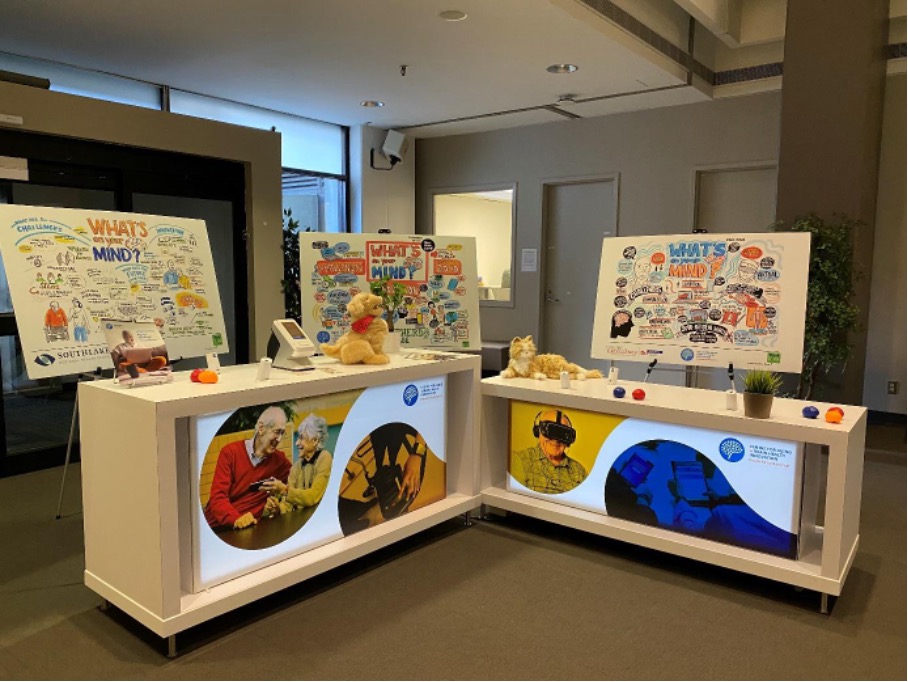
There is an example from overseas: an NPO called CABHI (CABHI, *3), headquartered in Toronto, Canada. They are engaged in activities aimed at solving aging-related issues through technology, collaborating with developers under the leadership of stakeholders from the care and medical fields. Their approach starts with the needs of the front lines.CABHI members clarify the needs of the care and medical fields and provide mentoring while offering opportunities for developers to learn design thinking and design sprints, enabling them to work together on product development. CABHI’s role is to cultivate personnel who can serve as coordinators in these settings and to expand these efforts into viable business ventures. At the same time, they also offer consulting services that involve actual care facilities in the prototyping and refinement of devices.This creates a virtuous cycle in which products are improved based on a “comprehensive on-site evaluation” that reflects the opinions of not only caregivers but also those receiving care.
―― The role of the coordinator is indeed crucial.
For companies whose primary business is product development, it can be difficult to maintain a direct point of contact with care facilities while also conducting product evaluations. This is even more challenging for small and medium-sized enterprises. Therefore, there is a need for organizations—whether public or private—to emerge that can take on the demand from companies for on-site evaluations and act as intermediaries and agents.
※3:CABHI, Centre for Aging and Brain Health Innovation (https://www.cabhi.com/)