
As Japan’s population continues to age and birth rates decline, there is a growing need for “care technology” that can help improve productivity in the long-term care sector. This page provides an overview of productivity improvement in the long-term care sector and explains the process for implementing initiatives to enhance productivity in this field.
Improving productivity in the long-term care sector is intended not only to reduce the workload on staff through operational improvements and the use of care technologies—such as care robots and ICT—but also to enhance the quality of care services. This is achieved by redirecting the time saved through operational improvements and efficiency gains toward direct care activities, thereby increasing the time staff spend interacting with service users.Examples of productivity improvements in the care sector include not only the use of technology but also reducing staff burdens through appropriate staffing and reviewing management methods for equipment and supplies, as well as helping staff clarify the objectives of care and re-evaluate their current duties so they can recognize the necessity of their work and improve their motivation.
To improve productivity in the long-term care sector, it is important to implement the PDCA cycle by following these six steps: Step 1: Prepare for improvement activities; Step 2: Identify on-site challenges; Step 3: Develop an action plan; Step 4: Implement improvement activities; Step 5: Review improvement activities; and Step 6: Revise the action plan.
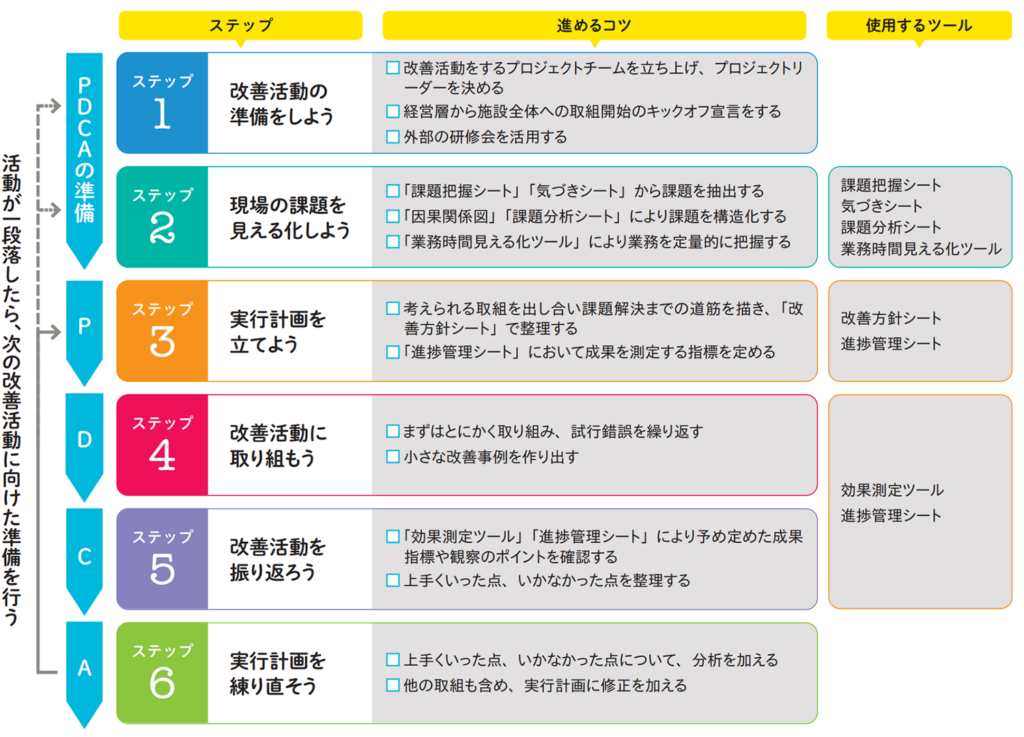
Source: Guidelines for Improving Productivity (Operational Improvements) in Long-Term Care Services, Ministry of Health, Labour and Welfare, p. 17
For details on each step, please refer to the "Guidelines for Improving Productivity (Operational Improvements) in Long-Term Care Services" issued by the Ministry of Health, Labour and Welfare.
Please also refer to the Ministry of Health, Labour and Welfare’s “Productivity Improvement Portal for the Long-Term Care Sector.”