
Project to Promote the Development of Robotic Care Equipment, etc. (Infrastructure Development) (FY2021–2022)
Clinical Evaluation Guidance
- Guidance on Clinical Evaluation of Robotic Care Devices (for Companies Operating in Japan) First Edition
- Explanation of the First Edition of the Guidance on Clinical Evaluation of Robotic Care Devices (for Companies Operating in Japan)
Dissemination of Development Results
- "Guidebook for the Development of Robotic Care Equipment" Seminar Presentation Materials (Detailed Version)
- "Guidebook for the Development of Robotic Care Equipment" Seminar Presentation Materials (Abridged Version)
Robotic Care Equipment Development and Standardization Project (FY2018–2020)
Results of the Standards Development and Evaluation Project
Final deliverable
- Safety Handbook for the Development of Robotic Care Equipment, 2nd Edition (Main Text)
- Safety Handbook for the Development of Robotic Care Equipment, 2nd Edition (Appendix)
- Guidelines for Demonstration Tests of Robotic Care Equipment, 2nd Edition
- Ethics Review Application Guidelines, 2nd Edition
Safety Assessment Criteria
Overseas Markets (CE Marking)
- CE Marking Procedure Manual
- Concept Implementation Verification Handbook
- Evaluation Framework
- Evaluation Test Methods
- Report on Overseas Research Related to the Development and Standardization of Robotic Care Equipment (Fiscal Year 2019)
- Report on Overseas Research Related to the Development and Standardization of Robotic Care Equipment (Summary Version)
- *Click here for the 2022 Overseas Survey Report
Effectiveness Evaluation Criteria
- Effect Evaluation Sheet *ZIP file (Excel)
- Method for Evaluating Gait Stability
Development Support
- Development and Implementation Process Evaluation Tool
Standardization
- Draft Revision of ISO 13482 (ISO TC299) *
- Draft Standard for Urinary Incontinence Management Devices (ISO TC173) *
- Draft Standard for Devices to Assist with Bowel Movements (ISO TC173) *
- Draft Standard for Companion and Communication Robots
- Draft Annex: Evaluation of Detection Performance of Monitoring Support Devices in Bathroom Mist Environments *
- Long-Term Care Data Conversion Tool
*Draft standards are not publicly available. Please contact the respective standardization committees.
Project to Promote the Development and Introduction of Robotic Care Equipment (FY2013–FY2017)
Results of the Standards Development and Evaluation Project
Final deliverable
- "Guidebook for Developing Robotic Care Equipment"
- "Safety Handbook for the Development of Robotic Care Equipment (Main Text)"
- "Safety Handbook for the Development of Robotic Care Equipment (Appendix)"
- "Guidelines for Demonstration Tests of Robotic Care Equipment"
- "Guidelines for Ethics Review Applications"
- "Guidelines for the Development and Introduction of Robotic Care Devices"
Safety Assessment Criteria
- Risk Assessment Template (343 KB)
- Safety Handbook for the Development of Robotic Care Devices
- Intrinsically Safe Design Support Tool for Robotic Care Equipment
- Safety Design Guidelines (3.3MB)
- Collection of Safety Design Case Studies (1.2 MB)
- Accident Prediction Model Adapted to the Condition of Care Recipients (1.0 MB)
Performance Standards
- Development Concept Sheet Based on the ICF (103 KB)
- Efficiency and Risk Assessment Indicators for Long-Term Care Services
- Design support tool based on a mechanical model
- Simple Motion Measurement and Evaluation System
- Simulator for Elderly Movement
- IoT System for Evaluating the Effectiveness of Robotic Care Devices
Development and Validation Test Criteria
- Guidelines for Demonstration Tests of Robotic Care Equipment
- Evaluation Criteria for Robotic Care Devices
- Guidelines for Ethics Review Applications
- Guidelines for the Development and Introduction of Robotic Care Equipment
Promotion of Standardization
- Transfer assistance (wearable devices), monitoring support (for care facilities and home care)
- Transfer assistance (non-restraint), mobility assistance (indoor and outdoor), bathing assistance, and toileting assistance
Survey on the Development of Robotic Care Equipment
- Report on a Large-Scale Demonstration Trial Regarding the Use of Communication Robots in the Long-Term Care Sector (1404 KB) Revised Version (July 27, 2017)
- Survey on the Demand for Robotic Care Equipment (FY 2016) (463 KB)
- Survey on Advanced Long-Term Care Services (FY 2016) (1.2MB)
- Guidelines for the Use of Robotic Care Equipment (FY 2016) (1.1MB)
- Survey of Overseas Technologies Related to Robotic Care Equipment (FY2016) (4.4MB)
- Analysis of Care Service Operations for Evaluating the Effectiveness of Robotic Care Devices (FY 2016) (1.5MB)
Results of the Development Assistance Program
The "Project to Promote the Development and Introduction of Robotic Care Equipment" provides development grants to companies and other entities committed to commercialization, with the aim of promoting the development and practical application of robotic care equipment in priority areas. This initiative is referred to as the "Development Grant Program," and the organizations implementing it are called "Grant Recipients."The primary outcome of the "Development Grant Program" is the commercialization of useful robotic care devices. Furthermore, even in cases where commercialization is not achieved, the product development process has contributed to the accumulation of various insights by the "grant recipients."
Product Implementation Examples
Robots developed through a government-funded project
Project to Promote the Development and Adoption of Robotic Care Equipment
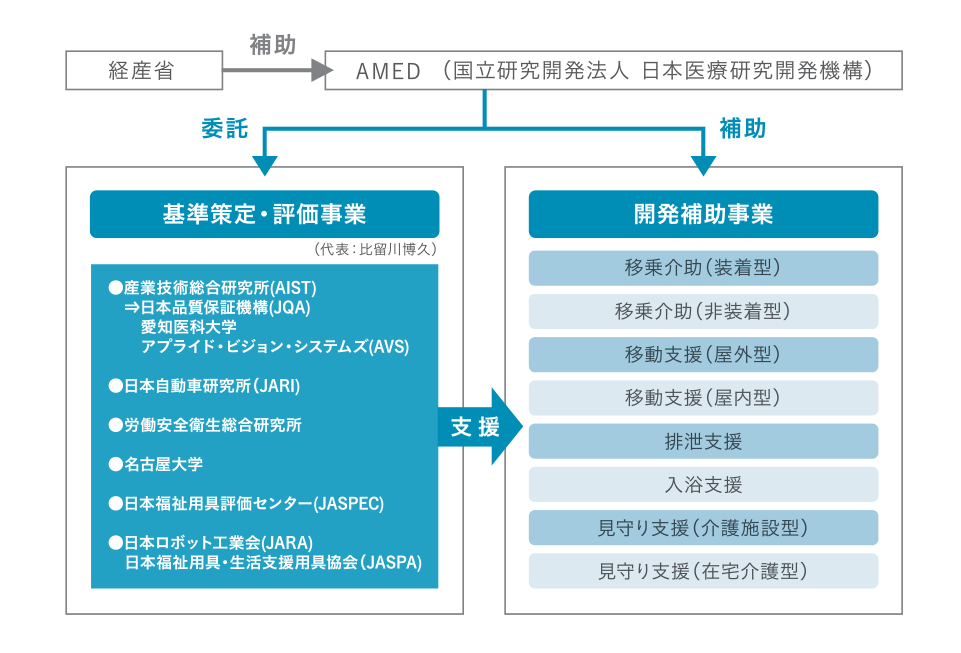
The Ministry of Economy, Trade and Industry (METI) launched the "Robotic Care Equipment Development and Introduction Project" in fiscal year 2013 with the aim of creating new markets for robotic care equipment by supporting the development and introduction of such equipment in priority areas, thereby promoting the independence of people requiring care and reducing the burden on care workers. The Robotic Care Equipment Development
and Introduction Promotion Project consists of the following two initiatives:
1. Development Grant Program
: To promote the development and practical application of robotic care equipment, grants are provided to companies seeking to commercialize products in priority areas. 2
. Standards Development and Evaluation Program
: To facilitate the introduction of robotic care equipment into care settings, this program clarifies guidelines for new care programs utilizing the technology, as well as guidelines for demonstration experiments, standardization research, and development guidelines.
Business Structure
Business and Care Robot Portal Site
The primary objectives of the Care Robot Portal are to support initiatives that promote the development and adoption of care robots and to publicize the results of these efforts. Additionally, the portal aims to contribute to raising public awareness of care robots and fostering their widespread adoption.
Basic Guidelines for Robot Development
Although research and development into care robots has become increasingly active, they are still in the early stages of research and development on the path to “practical application.” The “Project to Promote the Development and Introduction of Robotic Care Equipment” is an
initiative being advanced toward this practical application. It establishes the following two points as basic policies for the development of practical robotic care equipment
. Basic Policy
1
: View the purpose and effectiveness of robotic care equipment in terms of their impact on “people.” The goal is not merely to pursue mechanical performance. We will develop and utilize care robots with a clear overarching objective: to “improve people’s lives and quality of life.” Basic Policy 2
: Position robotic care devices as physical care tools for practicing “enhanced care.” They are not merely supplementary care tools designed to compensate for physical limitations. Instead, they are positioned within a comprehensive care program that takes into account the interrelationship with care provided by human caregivers.
(Links to Reference and Related Materials)