
Results and Future Outlook for the Robotic Care Equipment Business
It has been quite some time since concerns began to arise regarding a shortage of care workers in the long-term care industry, driven by the effects of Japan’s aging population and declining birthrate. Furthermore, in recent years, the approach to long-term care has been reevaluated. The focus has shifted from merely providing personal care for the elderly and those requiring care to supporting their long-term independence, enabling them to perform as many tasks as possible on their own for as long as possible, and providing care that respects their wishes and dignity.At the same time, there is a growing emphasis on the well-being of both caregivers and care recipients, ensuring that both parties can maintain a state of physical and mental happiness.
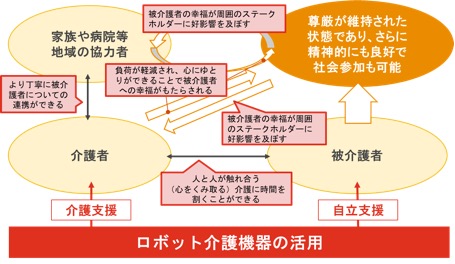
As shown in Figure 1, the use of robotic care devices can provide support to caregivers and promote independence among care recipients, ultimately leading not only to improved physical and mental health but also to increased motivation for social participation. (For information on the types of robotic care devices, please refer to the “Key Areas” section.)
Figure 1: The Desired Future State of Robot Technology Utilization
Source: PwC Consulting LLC, “Survey Report on the Achievements and Challenges of the Robotic Care Equipment Business and the Development of the Care and Welfare Equipment Business (Conducted in FY2020).” Commissioned by: Japan Agency for Medical Research and Development (AMED). *Partially modified.
What is the purpose of the robotic care equipment business?
The Robotic Care Equipment Initiative was launched by the Ministry of Economy, Trade and Industry in fiscal year 2013. Its objective is to support the development and introduction of robotic care equipment in “priority areas for the application of robotics in caregiving,” with the aim of creating a new market for such equipment by promoting the independence of care recipients and reducing the burden on caregivers.The background to this initiative is that, while there is strong anticipation for the use of robot technology in care settings to alleviate the burden on caregivers, development and commercialization in the field of robotic care equipment have often stalled due to the following three challenges:
• Lack of clear market viability
• Development requires special considerations
• User feedback is difficult to convey to developers.
Therefore, to address these challenges, the Ministry of Economy, Trade and Industry launched this initiative based on the following three concepts:
① Identify priority areas (see next page) based on on-site needs (needs-oriented)
② Accelerate improvements in usability and cost reduction using the stage-gate method [1] (affordability)
③ Provide public support and institutional measures for on-site implementation (At scale) [2]
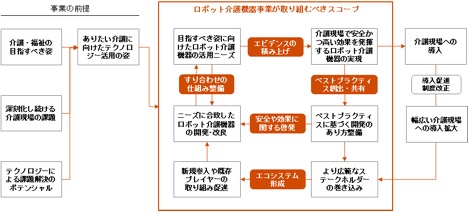
The premise of this project is to resolve the ever-worsening challenges in the care sector through the utilization of technology by realizing the development and introduction of devices based on actual needs, thereby achieving the ideal state of care and welfare. To accelerate the launch of the robotic care equipment industry, it is considered essential to define current challenges and the scope of future initiatives, as shown in Figure 2.To this end, it is expected that each of the key areas for robotic care equipment will be addressed and realized through this project. For the development of the robotic care equipment industry, we believe it is possible to support the development and improvement of equipment aligned with the needs of care settings by raising awareness among developers regarding safety and efficacy considerations. Furthermore, by accumulating best practices alongside evidence, we believe that robotic care equipment will make broad contributions in care settings and help establish the industry.
Figure 2: Scope of Activities for the Robotic Care Equipment Industry
Source: PwC Consulting LLC, “Survey Report on the Achievements, Challenges, and Development of the Robot-Assisted Care Equipment Business (Conducted in FY2020)” Commissioned by: Japan Agency for Medical Research and Development (AMED)
To begin with, why do the initiatives of the Ministry of Economy, Trade and Industry (METI) and AMED proceed based on the concept of “robotic care devices” rather than “care robots”? The underlying philosophy is that robots are not the primary focus; rather, “care devices remain the main focus, and it is the care devices that are becoming robotic.”The concept of robotic care devices does not assume that robots will perform care tasks entirely on their own. Instead, it views these devices as tools that enable more effective care when users operate and master them. Consequently, the development process places significant emphasis on the user’s perspective. The original vision at the start of the initiative was to achieve better care by effectively integrating robots with human-provided care, and that vision remains unchanged today.
Past Projects and Their Results
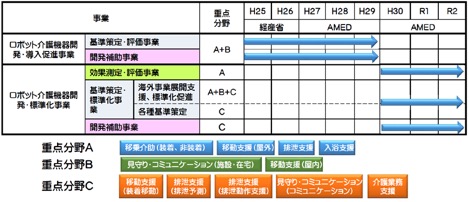
The history of the robotic care equipment sector spans just under 10 years. In fiscal year 2013, the Ministry of Economy, Trade and Industry (METI) launched the “Project to Promote the Development and Introduction of Robotic Care Equipment.” Following the establishment of AMED in fiscal year 2015, this project was transferred to AMED and continued through fiscal year 2017. Under this METI initiative, the focus was on “standard-setting and evaluation projects” and “development grant programs.”
Subsequently, from fiscal year 2018 through fiscal year 2020, the initiative continued under the Japan Agency for Medical Research and Development (AMED) as the “Robotic Care Equipment Development and Standardization Project.” AMED’s project centered on “Effect Measurement and Evaluation,” “Standard Setting and Standardization,” and “Development Grant Programs.”
Figure 3: Promotion of the Development and Introduction of Robotic Care Equipment
Source: Japan Agency for Medical Research and Development (AMED), “Promotion of the Development and Introduction of Robotic Care Equipment” (https://www.amed.go.jp/content/000059153.pdf)
The "Project to Promote the Development of Robotic Care Equipment" was launched in fiscal year 2021 and consists of two main components: "Development Grants" and "Infrastructure Development." The breakdown is as follows:
1. "Project to Promote the Development of Robotic Care Equipment (Development Grants)"
1-A. Support for the Development of Robotic Care Equipment [Development Grants]
2. "Project to Promote the Development of Robotic Care Equipment (Development Grants)"
2-A. Study on the Formulation of Quantitative Safety Standards [Formulation of Safety Standard Guidelines]
2-B. Environmental Preparation, Including the Formulation of Clinical Evaluation Guidance for Overseas Expansion[Formulation of Clinical Evaluation Guidance for Overseas Expansion, etc.]
2-C. Dissemination of Developed Outcomes [Dissemination of Development Outcomes]
For projects starting in fiscal year 2021 and beyond, we will leverage the results of previous projects to accelerate development that addresses unresolved challenges in care settings—including home care—as well as changes in care environments caused by the COVID-19 pandemic. Additionally, these initiatives aim to accelerate the business expansion and overseas deployment of existing products.
1-A. Under [Development Grants], we will support the “development of target devices and systems for 13 items across 6 priority areas,” targeting settings such as home care that support the independent living of older adults, as well as the “development of devices and systems contributing to infection control measures in care settings,” targeting settings prone to close contact, such as group-based preventive care programs.
2-A. Under [Formulation of Safety Standards and Guidelines], while previous projects focused on developing and compiling risk assessment methods and design/testing standards for safe equipment, this project will work on providing examples of quantitative standards using more specific products as case studies.
2-B. Under [Formulation of Clinical Evaluation Guidance for Overseas Expansion, etc.], we will work on formulating clinical evaluation guidance for companies expanding overseas and for companies operating domestically.
2-C. [Dissemination of Development Results]: We will work to promote the dissemination of development and adoption through initiatives such as encouraging the use of existing guidance and manuals, creating best practices for the introduction of developed devices, and fostering a community for robotic care devices.
It is expected that these four initiatives, working in harmony, will help promote a vision of better care utilizing Japanese-developed robotic care devices.
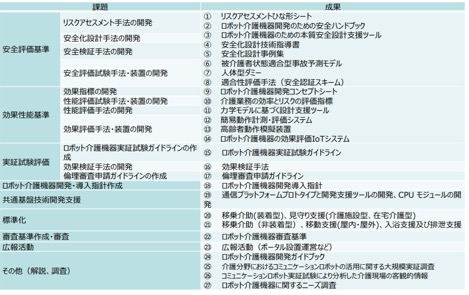
Figure 4: List of Outcomes from Standard Development and Evaluation Projects (27 Projects)
 Overview of the "Project to Promote the Development and Introduction of Robotic Care Equipment" R&D Project (Final Evaluation) June 12, 2020, Robot Policy Office, Industrial Machinery Division, Manufacturing Industries Bureau
In addition, under the development assistance program, 112 projects were selected between fiscal year 2013 and fiscal year 2020, and as of the end of fiscal year 2020, 28 of these had been put into practical use.
Figure 5: Overview of the "Development Grant Program" under the Robot Care Equipment Development and Standardization Project
 *The adoption year for one derivative model is
unknown. Source: PwC Consulting LLC, “Survey Report on the Achievements and Challenges of the Robotic Care Equipment Business and the Development of the Care and Welfare Equipment Business (Conducted in FY2020).” Commissioned by: Japan Agency for Medical Research and Development (AMED)
Future Initiatives
The "Robotic Care Equipment Development Promotion Project" was launched in fiscal year 2021 and consists of two main components: "Development Grants" and "Environmental Improvement." The breakdown is as follows:
1. "Robotic Care Equipment Development Promotion Project (Development Grants)"
1-A. Support for the Development of Robotic Care Equipment [Development Grants]
2. "Robotic Care Equipment Development Promotion Project (Development Grants)"
2-A. Study on the Formulation of Quantitative Safety Standards [Formulation of Safety Standard Guidelines]
2-B. Environmental Improvement, Including the Formulation of Clinical Evaluation Guidance for Overseas Expansion [Formulation of Clinical Evaluation Guidance for Overseas Expansion, etc.]
2-C. Dissemination of Developed Outcomes [Dissemination of Development Outcomes]
For projects starting in fiscal year 2021 and beyond, we will leverage the results of previous projects to accelerate development that addresses unresolved challenges in care settings—including home care—as well as changes in care environments caused by the COVID-19 pandemic. These initiatives will also aim to accelerate the business expansion and overseas deployment of existing products.
1-A. Under [Development Grants], we will support the “development of target devices and systems for 13 items across 6 priority areas,” targeting settings such as home care that support the independent living of elderly individuals, as well as the “development of devices and systems contributing to infection control measures in care settings,” targeting settings prone to close contact, such as group-based preventive care programs.
2-A. Under [Formulation of Safety Standards and Guidelines], while previous projects focused on developing and compiling risk assessment methods and design/testing standards for safe equipment, this project will work on providing examples of quantitative standards using more specific products as case studies.
2-B. Under [Formulation of Clinical Evaluation Guidance for Overseas Expansion, etc.], we will work on formulating clinical evaluation guidance for companies expanding overseas and for companies operating domestically.
2-C. [Dissemination of Development Results]: We will work to promote the dissemination of development and adoption through initiatives such as encouraging the use of existing guidance and manuals, creating best practices for the introduction of developed devices, and fostering a community for robotic care devices.
It is expected that these four initiatives will work in harmony to promote a vision of better care utilizing Japanese-developed robotic care devices.
In closing
As Japan faces a society with a declining birthrate and an aging population, addressing challenges related to long-term care is crucial for the future of Japanese society. Robotic care devices can help support the independence of the elderly, preserve the dignity of care recipients, assist caregivers and family members, and alleviate labor shortages in the care sector. To achieve this, raising awareness among as many people as possible about the existence of these devices and promoting their proper and effective use will lead to the development of even better equipment.Furthermore, it is expected that future developments will include the creation of robotic care devices capable of providing support for home-based care, as well as the exploration and implementation of improved care models through system integration with various other devices.
[1] Although the stage-gate method was adopted in the initial phase of the project, it was discontinued partway through.
[2] Overview of the "Project to Promote the Development and Introduction of Robotic Care Equipment" R&D Project (Final Evaluation) June 12, 2020, Robot Policy Office, Industrial Machinery Division, Manufacturing Industry Bureau