Providing Users with "Peace of Mind" and "Better Care"—
Maiko Ito and Takashi Miyamoto of Zenko-kai Discuss the Near Future of Technology-Driven Care
While labor shortages are a pressing issue across all industries, the severity of this problem in the long-term care sector is growing year by year. Amid these staffing shortages, the challenge lies in how to improve productivity while maintaining attentive care for those in need. Among the industry’s shared challenges, the introduction of care robots and ICT devices is gaining attention as a potential solution.
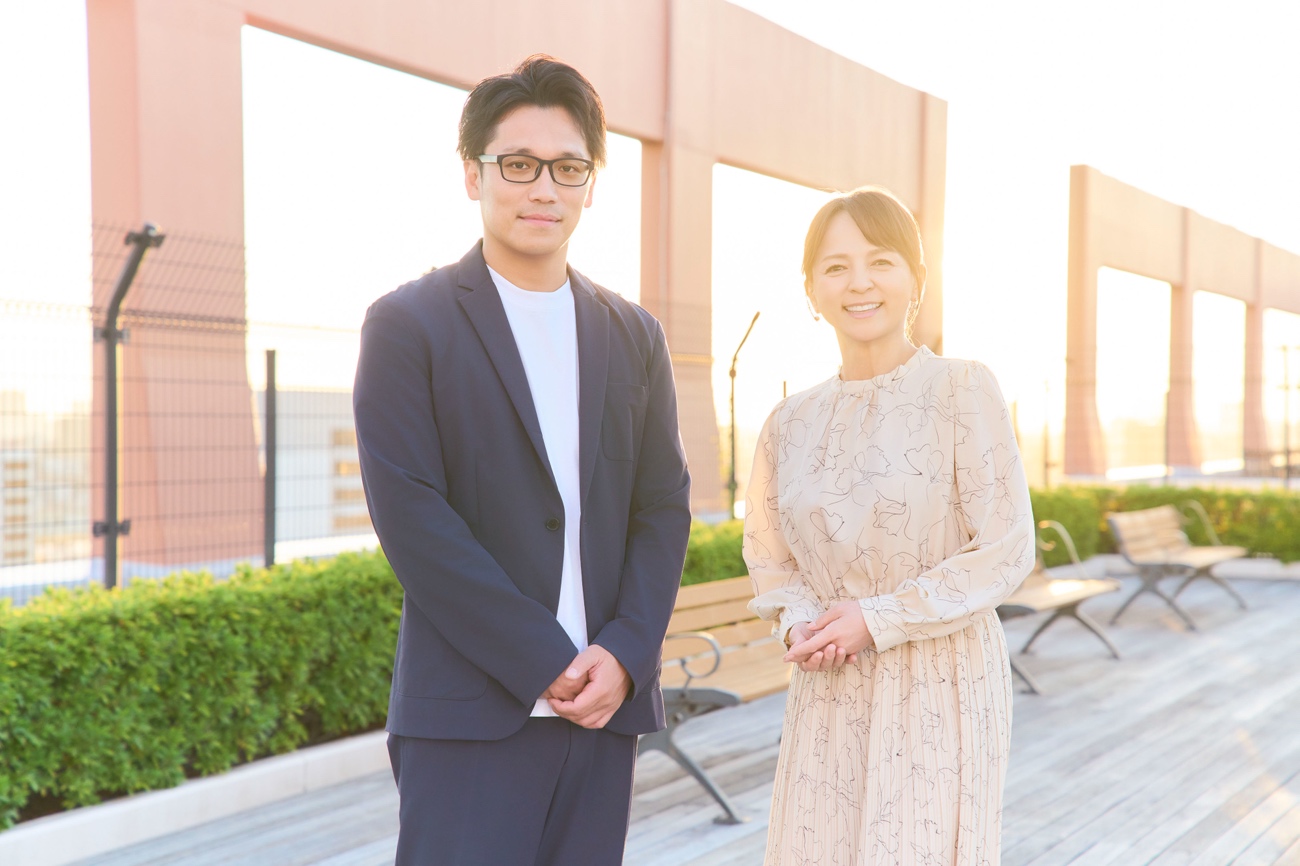
In this article, Takashi Miyamoto—Director, Chief Operating Officer, and Director of the Facilities Management Bureau at the Social Welfare Corporation Zenko-kai, which actively adopts care technologies such as care robots and ICT devices and engages in joint development and pilot testing with manufacturers—and Maiko Ito, a researcher and actress who studied medical and welfare robots as a doctoral student at Waseda University, discuss the challenges facing care tech and the ideal future of caregiving.
——Santa Fe Garden Hills, a multi-purpose welfare facility operated by Zenko-kai, has been actively adopting care tech. What was the underlying reason for deciding to implement this technology in the first place?
Takashi Miyamoto (hereinafter Miyamoto):
Our society is facing a reality of a declining birthrate and an aging population, and the working-age population is shrinking.In the future, there will be fierce competition for staff, and with the number of people requiring care expected to rise steadily, there will be an absolute shortage of caregivers. To address this, the entire caregiving industry is being compelled to adopt technology.
For our organization, our first step was introducing the "HAL" exoskeleton in 2009. We began considering its adoption after hearing caregivers say, "We’d like to try this," and it has not only helped create a more comfortable working environment for staff but has also reduced the burden on our residents.
――I hear that Santa Fe Garden Hills is attracting attention from peers in the industry as a facility that brings together cutting-edge technology. What kinds of care tech are currently being introduced in care settings?
Miyamoto:
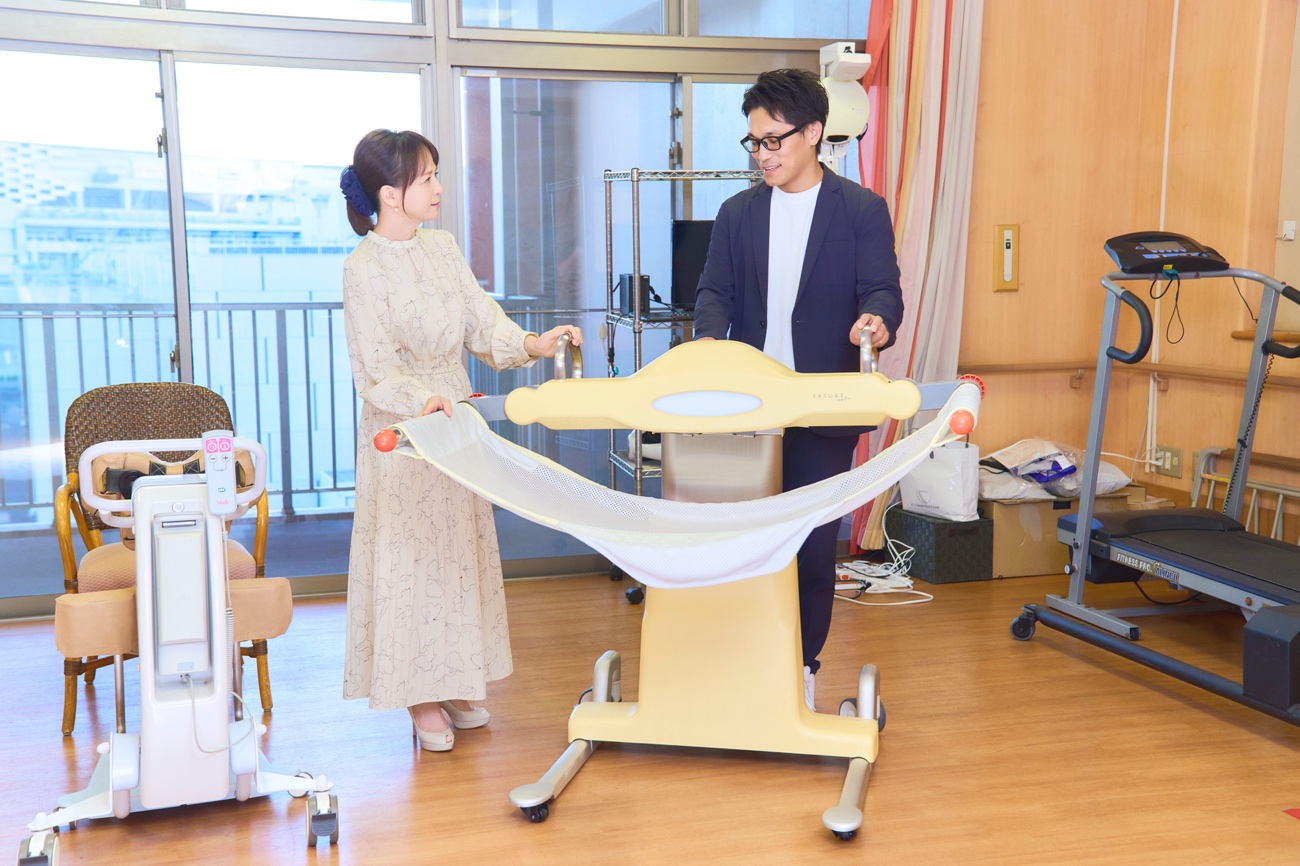
When it comes to care robots, I imagine many facilities have introduced the transfer robot “Hug” or “SASUKE,” which assists with lift-style transfers.I feel these technologies help reduce the physical strain on staff members’ legs and backs while providing a sense of security for the residents receiving care.
Additionally, “Sleep SCAN”—a well-known vital sign sensor that is placed under a resident’s mattress to monitor their sleep patterns and vital signs non-invasively from a separate room—is widely used. Furthermore, camera-based behavioral analysis sensors like “HitomeQ Care Support” are designed to alert staff if a resident exhibits movements requiring attention, such as a fall.
Maiko Ito (hereinafter referred to as Ito):
So cutting-edge technology is making its way into the world of long-term care. My mother was also in a care facility, and as a resident, you naturally want to live as normally as possible. I really appreciate the thoughtful features designed to make residents feel at ease—such as the contactless sensor placed under the mattress, or the room cameras that only alert staff when unusual movements are detected.
Miyamoto:
Long-term care services are meant to provide a living environment.I believe the role of those involved in caregiving is to create an environment that is comfortable and as stress-free as possible for both the resident and their family. Additionally, products like “DFree”—a urination prediction support device that visualizes each resident’s urination timing—have been developed. By providing assistance at the necessary moments, this generates positive effects such as reducing the burden on both residents and caregivers.
Creating a good environment for residents also leads to a more comfortable workplace for staff.For example, since the measurement data from “Sleep SCAN” can be viewed all at once on a screen, it reduces the burden on staff during rounds. This creates more time and mental and physical leeway, leading to improved service quality—such as more active communication with residents and reduced wait times for them.
Ito:
In care settings, it’s not uncommon for a resident to have fallen by the time staff notice them in their room. In such cases, having data that explains the situation brings great peace of mind to families.
Miyamoto:
That’s right. At our facility, we utilize various channels to contact families. Some prefer phone calls, while others ask to be notified of the situation via chat or email first, saying, “I get so anxious waiting to return a missed call.” We aren’t fixated on using technology; what matters most is how we can provide peace of mind to residents and their families.
Research for the Future: Insights Gained from Firsthand Experience on the Ground
――What initially led the two of you to get involved in the caregiving and welfare sectors?
Miyamoto:
I joined Zenko-kai right after graduating from college. While part of it was because I majored in social welfare, I also felt that the accelerating decline in birthrates and aging population presented clear social challenges in this field. I’m from a rural area in Chiba Prefecture where I had many opportunities to interact with the elderly, so I thought that if I gained experience in the caregiving sector, I might be able to return to my hometown and work there.
Ito:
At the age of 45, I decided to go to college because I wanted to “give back to society” and “engage with academia” to achieve that. From that point on, I focused on the well-being of the elderly and believed it was crucial to engage in preventive care to ensure that life expectancy and healthy life expectancy do not diverge.After studying preventive medicine, I joined a robotics seminar, which led me to become involved in developing robots to prevent locomotive syndrome (a condition where the function of the musculoskeletal system declines due to age-related muscle weakness, joint or spinal diseases, osteoporosis, etc., causing difficulties in daily life). In graduate school, I collaborated with companies to develop a robot that assists with squats, designed for use in nursing care facilities.Thanks to advice from those around me and encounters with people who offered to work with me, I found myself, before I knew it, continuing on to the doctoral program.
Miyamoto:
That’s wonderful. As you say, I think the preventive perspective—focusing on what we can do to avoid needing long-term care in the first place—is incredibly important.
Ito:
Having cared for my own parents, I truly understand how much happiness it brings to a person to be able to walk on their own and live independently right up until the very end of their life.
I’ve heard that you, Mr. Miyamoto, not only introduce new care tech products but also engage in joint development.
Miyamoto:
When using products, I sometimes feel that they’re “difficult to use” or that they were “designed without understanding the realities of the care setting or the condition of the users.” In some cases, providing this feedback has led to me being invited to participate in the development process. There are also manufacturers entering the market with the expectation that technologies originally developed for different fields might be applicable to caregiving. By conveying feedback from the perspective of practicality in the field, I hope to help them create better products and ultimately improve productivity on the front lines.
"I want them to walk on their own two feet no matter what"—a commitment to ongoing research
――Given your involvement in the care and welfare sector, how do you view the evolution of care tech? Could you also share the principles you’ve prioritized in developing care tech?
Ito:
I started developing robots right around the time I began caring for my father. Since we lived apart, I managed to make do with a simple monitoring sensor so I could rush over immediately if anything happened, but my anxiety never truly subsided.Today, seeing these cutting-edge systems, I was amazed at how far they’ve come. I can’t help but think that if we could have monitored his condition by collecting data and predicting his status back then, my peace of mind would have been completely different. This progress is only possible because of the hard work of everyone on the front lines of care—including Zenko-kai—and the development companies.
Miyamoto:
The caregiving industry tends to be very precedent-driven, so introducing new systems often involved a lot of hard work to resolve conflicts on the ground one by one. However, our organization’s fundamental stance is to foster a culture of taking on new challenges, so we were able to push forward with the mindset that “if no one has done it before, we’ll create our own precedent and build evidence from it.”
Still, the introduction of sensing technology and IoT is merely a means to an end. To truly make the most of this technology, we need people who can utilize it—otherwise, it’s a dead end.To foster talent across the entire industry, we established the “Smart Care Worker” certification in 2019. This certification recognizes care workers who can contribute to improving efficiency on the front lines by utilizing care robots and sensors. We believe that talent development is a critical challenge for the industry.

Ito:
I believe the reason I was able to keep learning in the uncharted territory of robot development was because my determination to “help people walk on their own two feet, no matter what” never wavered.
I think there are many people who, if they were living a normal life, would see their muscle strength decline until, before they knew it, they were nearly bedridden. The desire to support people in living a happy and fulfilling life was the driving force behind our development.
Miyamoto:
While our facility is home to residents who already require care, we still want each person to fully enjoy a life that is true to who they are. That’s why our vision is “Care That Never Gives Up.” When people enter a state requiring care, both they and their families tend to give up prematurely, thinking, “I can’t do this” or “I can’t go there.” Even we, if we’re not careful, might start thinking, “This is good enough.”
What we prioritize in our services is creating a facility free of such resignation. By utilizing technology to predict residents’ conditions through data, we provide appropriate care tailored to each individual while reducing the workload on our staff. We believe that supporting the caregivers is key to creating an environment where residents can live with a smile.
Furthermore, by standardizing the systems we’ve developed and making them available to care facility operators nationwide, we aim to create sustainable care environments that will endure for the next 10 or 20 years.
▼ Profile:
Actress and Researcher;
Representative Director of My Company Co., Ltd.;
Representative Director of Light Staff Co., Ltd.
Maiko Ito
made her debut as an idol in 1983. While currently active as an actress, she also serves as the representative director of a television production company. In 2010, she enrolled at Waseda University. During her master’s program, she engaged in research on medical and welfare robots for the prevention of “locomotive syndrome.”She is currently enrolled as a research student at the same graduate school, studying anti-aging chemistry. In 2021, she served as a member of the Cabinet Office’s Council for the Future of Education.
Social Welfare Corporation Zenko-kai: Director / Chief Operating Officer / Director of Facilities Management
Zenko Comprehensive Research Institute Co., Ltd.: President and CEO
Takashi Miyamoto
Joined Zenko-kai in 2007 and has held his current position since 2017.In 2023, he established Zenko Comprehensive Research Institute and assumed the position of President and CEO. In addition to advancing the development of care systems from the perspective of frontline care workers and digital talent development programs, he serves as an executive for industry associations, a member of various committees for national and local governments, and participates as an expert in government meetings such as the Working Group on Healthcare, Long-Term Care, and Infectious Disease Countermeasures under the Regulatory Reform Promotion Council.