
Introducing a pilot study on robotic care devices
In today’s super-aging society, we face the challenge of a labor shortage in the caregiving sector. While demand for robotic care devices continues to rise, their widespread adoption has yet to reach a sufficient level.
Although robotic care devices serve a variety of purposes, “communicative robots” are particularly effective for recreational activities in care facilities and for monitoring family members who live apart.
In the development and manufacturing of robotic care devices, demonstration studies are conducted to verify the effectiveness of the devices, with the aim of developing more useful and high-performance equipment and promoting its adoption in care settings.
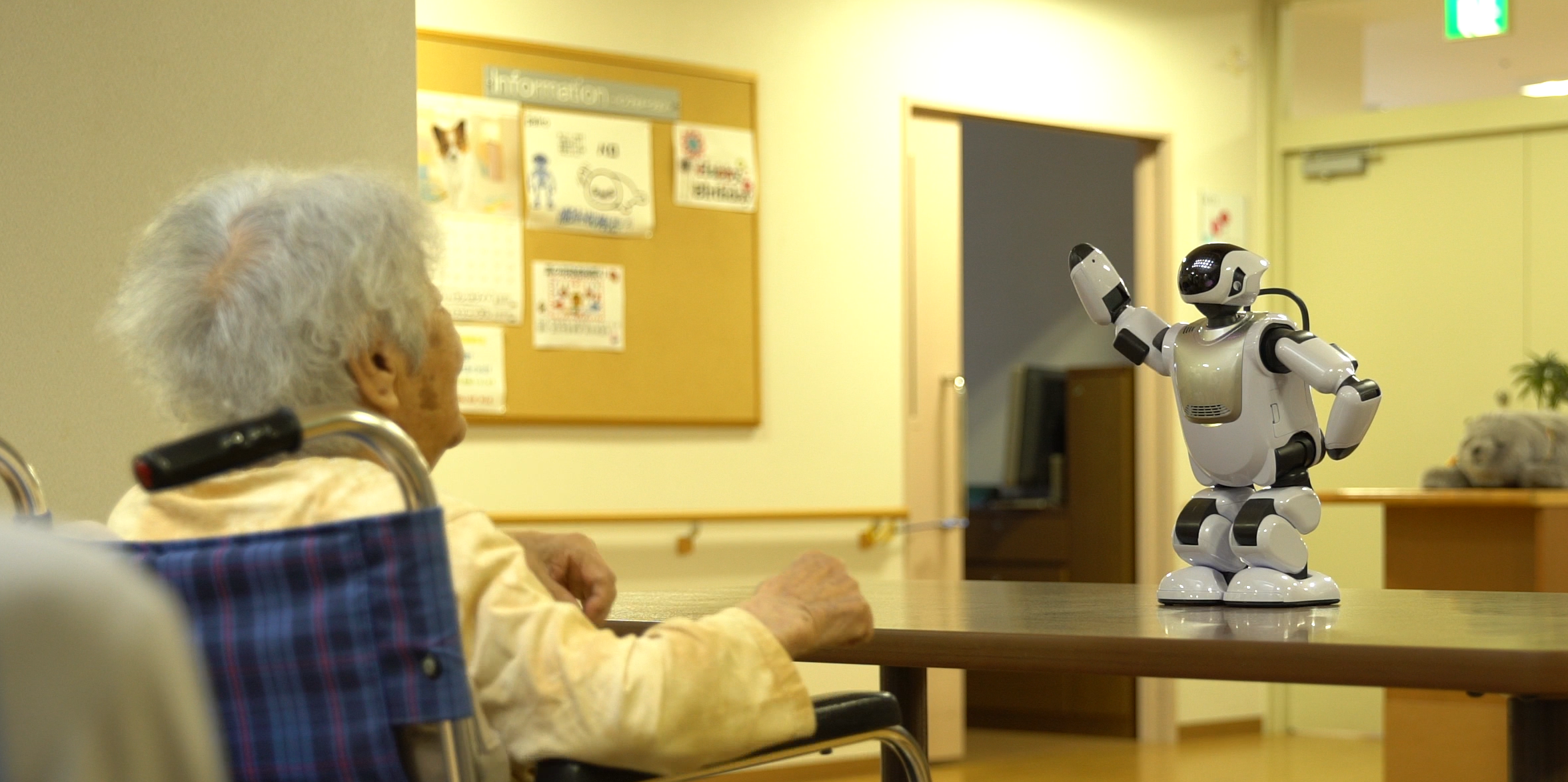
In this article, Mr. Tsuneoki Ninomiya of the PALRO Division, Product Business Headquarters at FUJISOFT Inc., discusses the demonstration studies and product development history of PALRO (a humanoid communication robot) developed by his company.
From the start of the pilot study to the present

PALRO was first launched in 2012 for use in senior care facilities.
At the time of its release, we had few connections with care facilities and were essentially feeling our way forward in terms of conducting field trials.
However, in 2013, PALRO was selected as one of the priority projects for Kanagawa Prefecture’s “Sagami Robot Industry Special Zone.” With the support of the Special Zone, we were able to conduct various field trials.
Initially, with the cooperation of Fujisawa City in Kanagawa Prefecture, we conducted a pilot program in which PALRO was loaned to 23 care facilities—including special nursing homes for the elderly and group homes for people with dementia—for two weeks each. Through this process, we verified PALRO’s usefulness and potential while also assessing the needs of care facilities and safety concerns, incorporating this feedback into our development. At that
time, communication robots were not included in the“Priority Areas for the Use of Robot Technology in Care” (hereinafter referred to as “Priority Areas”) did not include communication robots. Consequently, with continued support from Kanagawa Prefecture, we conducted various demonstrations at universities, research institutions, and within our own company, focusing on gathering evidence of the robot’s effectiveness for care recipients. Our goal was to expand the scope of application for communication robots (from those with mild to severe care needs) and to expand the items listed in the Priority Areas (by adding communication robots).
Subsequently, following a large-scale demonstration survey¹ conducted in fiscal year 2016 by the Japan Agency for Medical Research and Development (AMED) on the feasibility of utilizing “communication robots” in care settings, communication robots were added to the Priority Areas in 2017. Since then, eligibility for public support from the national government and local municipalities regarding development and implementation has expanded, marking a major turning point in the widespread adoption of these robots within the care industry.
Currently, with an eye toward revisions to nursing care reimbursement rates, we are continuously advancing development and demonstration efforts to gather evidence demonstrating effectiveness, with the aim of contributing to the government’s goal of improving productivity in nursing care settings.
Through these development and demonstration efforts, we have made improvements to both the software and hardware, and we currently offer the “PALRO Business Series Model III for Senior Welfare Facilities.”Furthermore, in 2018, we launched the “PALRO Gift Package” for elderly individuals living at home, and we continue to evolve while expanding our presence in the elderly care sector.
Building Relationships with Demonstration Facilities
For a software company like ours, it is extremely difficult to find nursing care facilities to serve as pilot sites and universities or research institutions to gather evidence from scratch. By participating in initiatives led by the national government and local municipalities, we have built a network and expanded our pool of pilot sites and partner organizations.
Regarding pilot sites, since facilities using PALRO for the first time require support ranging from initial setup to equipment operation, we also enlist the cooperation of existing client facilities depending on the pilot schedule and content. Consequently, we consider building relationships and establishing systems
with these existing clients to be crucial.Although this is a secondary effect, during the initial launch period from 2012 to 2014, there were few cases of robots being utilized in nursing care facilities. Consequently, the product’s innovative nature and the buzz it generated led to significant media exposure, which in turn served as PR for the facilities themselves—a factor that encouraged some facilities to cooperate with our pilot programs.
We believe that ensuring facilities participating in pilot programs can also reap benefits is a key element.
Due to the nature of the product, its intended use is not immediately apparent from its appearance. Therefore, ensuring that users actually try it out is the first step. We believe it is crucial to replicate successful cases from facilities where positive results were achieved while simultaneously clarifying the conditions necessary for those results.
Sharing the results of the pilot study in a creative way
We primarily publish our pilot study results on our company website to reach our target audience of senior care facilities.
For some facilities, we send brochures and flyers via direct mail, as these tend to catch the eye more effectively than a website.
The results published on our website highlight the effects associated with PALRO’s key features. For example, we provide evidence regarding the effectiveness of recreational activities conducted in collaboration with universities and research institutions in the past, as well as the effectiveness of our features for verbal prompts and encouragement.
Furthermore, we take care to ensure our explanations are accessible. We avoid overusing technical jargon and instead use plain language to break down complex concepts. For English-language papers, we include Japanese summaries to facilitate understanding.
On the other hand, since academic papers are particularly effective for reaching government agencies and research institutions, we collaborate with researchers at partner universities and research institutions (primarily in the medical and welfare fields) to have them write and publish papers on our behalf.
In particular, presenting at medical and welfare-related academic conferences allows us to directly appeal to professionals in these fields and spark their interest, which has led to further empirical research and the adoption of our solutions. Furthermore, academic papers have served as a catalyst for inquiries from government agencies, helping us effectively demonstrate the benefits of our solutions to the national government.
To make the most of the findings from the pilot study
Since the product’s launch, we have incorporated features based on feedback and suggestions from nursing care facilities.
We have also collected and analyzed data on malfunctions and other issues, using this feedback to inform development—including hardware improvements—to enhance functionality and improve safety and usability.
For features where usage methods have been established, we have collaborated with medical and welfare experts to gather evidence of their effectiveness, thereby validating their utility.
Regarding communication robots, due to the nature of the product, quantitative evaluation is difficult to ascertain, so we conducted multifaceted analyses using various evaluation metrics.
To translate the results of these demonstrations into actual adoption at care facilities, we strive to tailor our explanations to the specific type of facility and the roles of the staff.
For example, while we may use academic papers and metrics to demonstrate concrete effects to professionals such as doctors, occupational therapists (OTs), and physical therapists (PTs), we focus on presenting case studies in simple, easy-to-understand language to help frontline staff visualize the benefits. We believe striking the right balance in how we present and communicate these results is crucial.
The challenges and difficulties of empirical research, and motivation
Statistical data and analysis are necessary to enhance the credibility of the demonstration results.
In particular, we have received feedback that, when using the results as evidence to demonstrate effectiveness to the government, comparisons over a specific period (6 months to 1 year) and securing a sufficient number of participants are required. However, the reality is that it is financially challenging for our company to cover all the necessary equipment and personnel costs for the demonstration on our own.
As mentioned earlier, due to the nature of communication robots, it is difficult to quantify their effects, and the lack of clear outcomes to demonstrate their effectiveness remains a challenge. To clarify the metrics that will serve as future standards, we are proceeding with demonstrations and discussions while utilizing the Living Lab under the Ministry of Health, Labour and Welfare’s Platform Project 2).Regarding the ethical review required for conducting demonstration studies, new entrants to the caregiving sector are often unfamiliar with the process and currently face difficulties in obtaining approval.
While our company was able to proceed smoothly thanks to support received through initiatives in Kanagawa Prefecture’s “Sagami Robot Industry Special Zone” and Kitakyushu City’s National Strategic Special Zone, we feel that support needs to be expanded for companies that are unfamiliar with the ethical review process itself.
While we recognize that the widespread adoption of care robots still faces many challenges, we are proceeding with their development and implementation in the belief that they can contribute to maintaining and improving the quality of care, enhancing productivity, and supporting the physical and mental well-being of the elderly—serving as one solution to the shortage of care workers resulting from Japan’s declining birthrate and aging population.
[Reference]
- Large-Scale Field Trial on the Use of Communication Robots in Long-Term Care Settings
- Ministry of Health, Labour and Welfare: "Platform for the Development, Demonstration, and Dissemination of Care Robots"
- Inoue et al., Gerontechnology (2022) 21(1), 1-7 “Preliminary study on the benefits of using the PALRO® robot to facilitate leisure programs for older adults with dementia. Gerontechnology”
- Robotic Care Equipment Development and Standardization Project (Development Grant Program): "Development and Evaluation of Prompting Functions Aimed at Supporting the Maintenance and Improvement of Daily Living Functions in Individual Older Adults Using Communication Robots"
- Yu Taniguchi et al., Japanese Journal of Public Health, Vol. 66 (2019), No. 5, “Effects of an Exercise Program Using Humanoid Communication Robots on Physical and Cognitive Function in Community-Dwelling Older Adults: A Pilot Study”