Development of an Intrinsically Safe Design Support Tool for Robotic Care Equipment
Implementing intrinsically safe design requires conducting a proper risk assessment; however, developers without sufficient experience may find it difficult to perform risk assessments and implement intrinsically safe design correctly. Therefore, with the goal of facilitating the implementation of intrinsically safe design, we have developed an intrinsically safe design support tool that allows users to conduct risk assessments and implement intrinsically safe design while referring to case studies.
The Intrinsic Safety Design Support Tool was developed specifically for the development of robotic care devices, with the aim of providing a tool to assist in intrinsic safety design.When developing such devices, it is necessary to first conduct a risk assessment and then reduce risks by applying protective measures in the order of intrinsic safety design, safety guards, and usage information. However, developers entering the new field of robotic care devices require guidance on
what risks to anticipate and how to proceed with intrinsic safety design.
The Intrinsic Safety Design Support Tool has the following basic functions:
(1) Risk assessment functions: Conducting and recording risk assessments, viewing recorded risk assessment results, and printing risk assessment results
(2) Data editing functions: Adding, editing, and deleting data; creating and deleting relationships between data
(3) Data management functions: Account management; import/export of data and other items; database backup
(4) Editing the basic specifications of the target robotic care equipment
Using the Intrinsically Safe Design Support Tool, risk assessments are conducted according to the following procedure:
i) Determining the basic specifications of the target robotic care equipment and establishing restrictions on machinery
ii) Selection of risk estimation methods
iii) Establishment of risk evaluation criteria
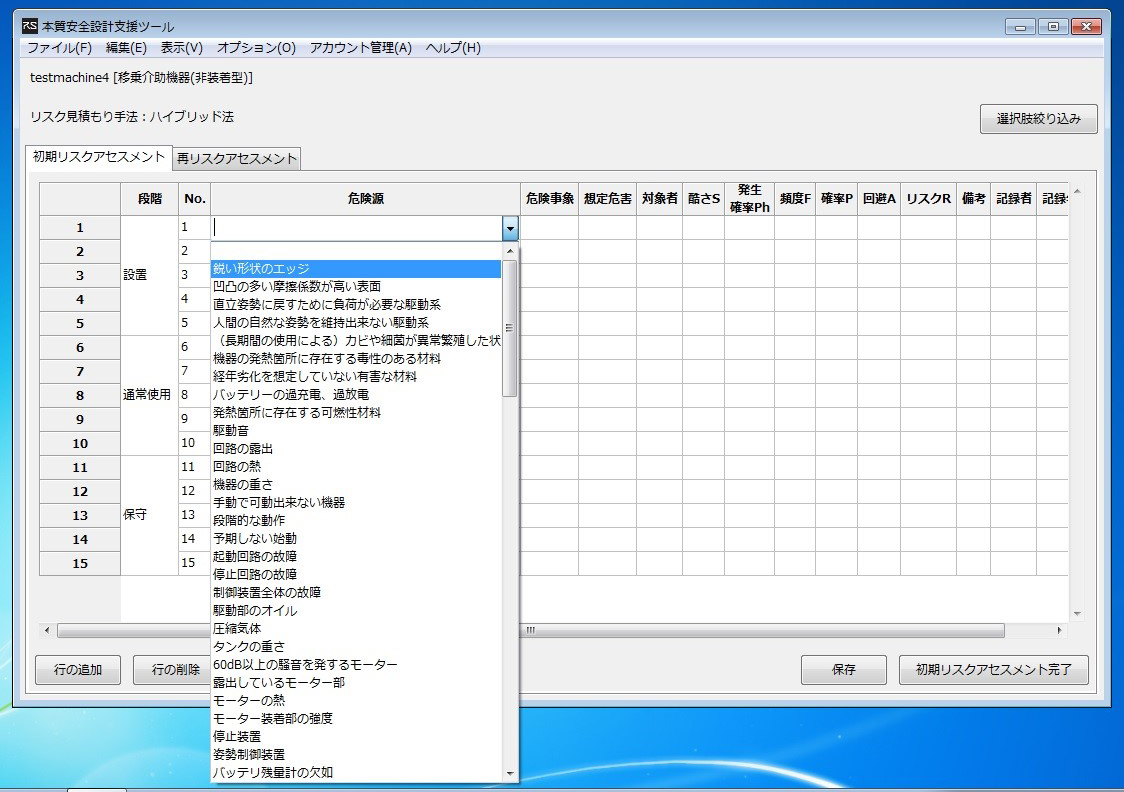
iv) Identification of hazard sources (Figure 1)
v) Identification of hazardous conditions and anticipation of hazardous events
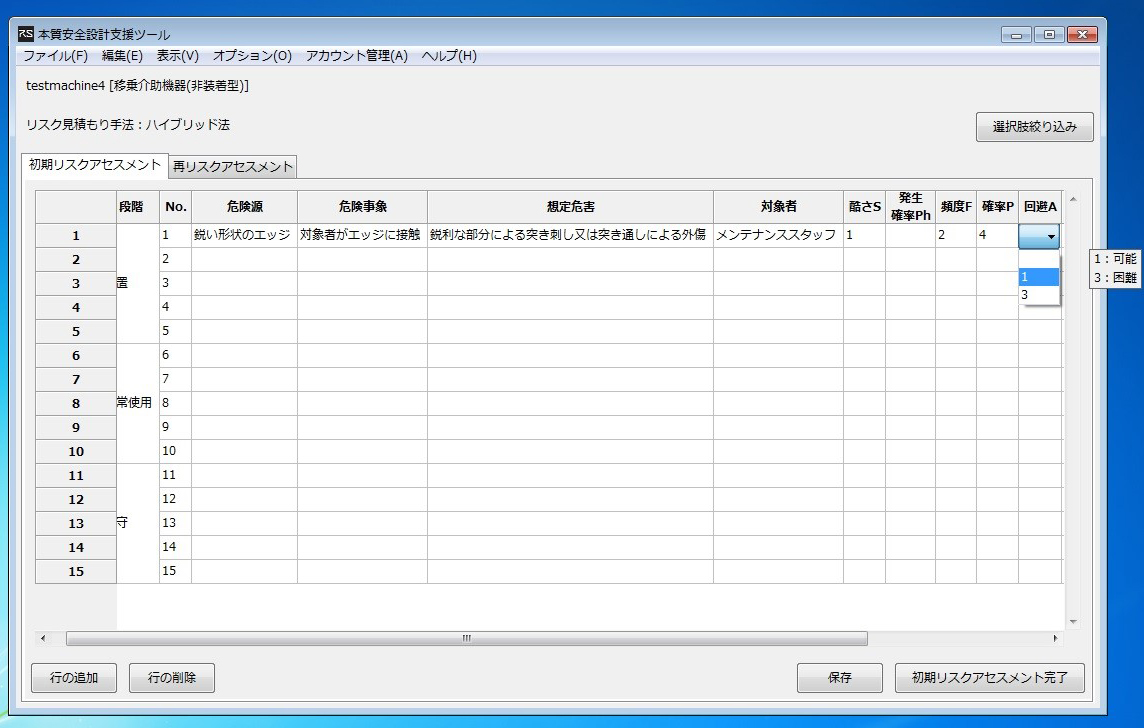
vi) Risk estimation (Figure 2)
vii) Risk evaluation
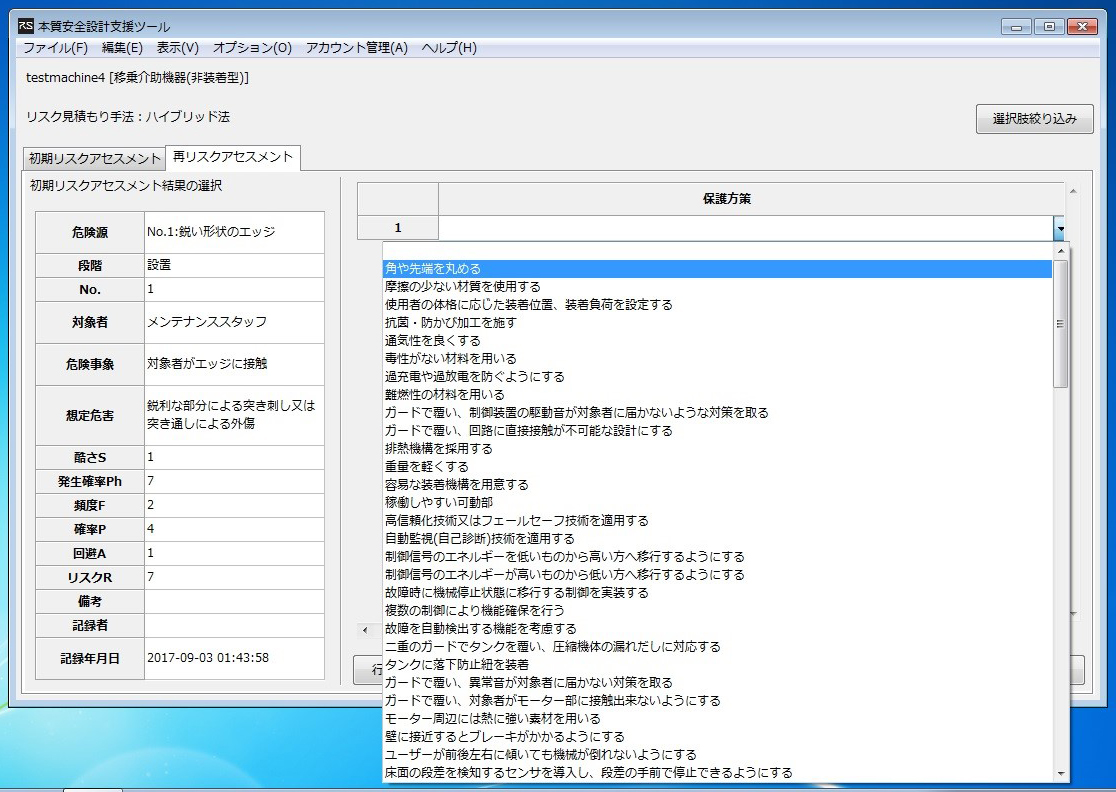
viii) Consideration of protective measures (Figure 3)
ix) Re-risk assessment (risk estimation, risk evaluation, and handling of residual risk)